ROI business case template
Turn value claims into a buyer-specific case with assumptions people can inspect.

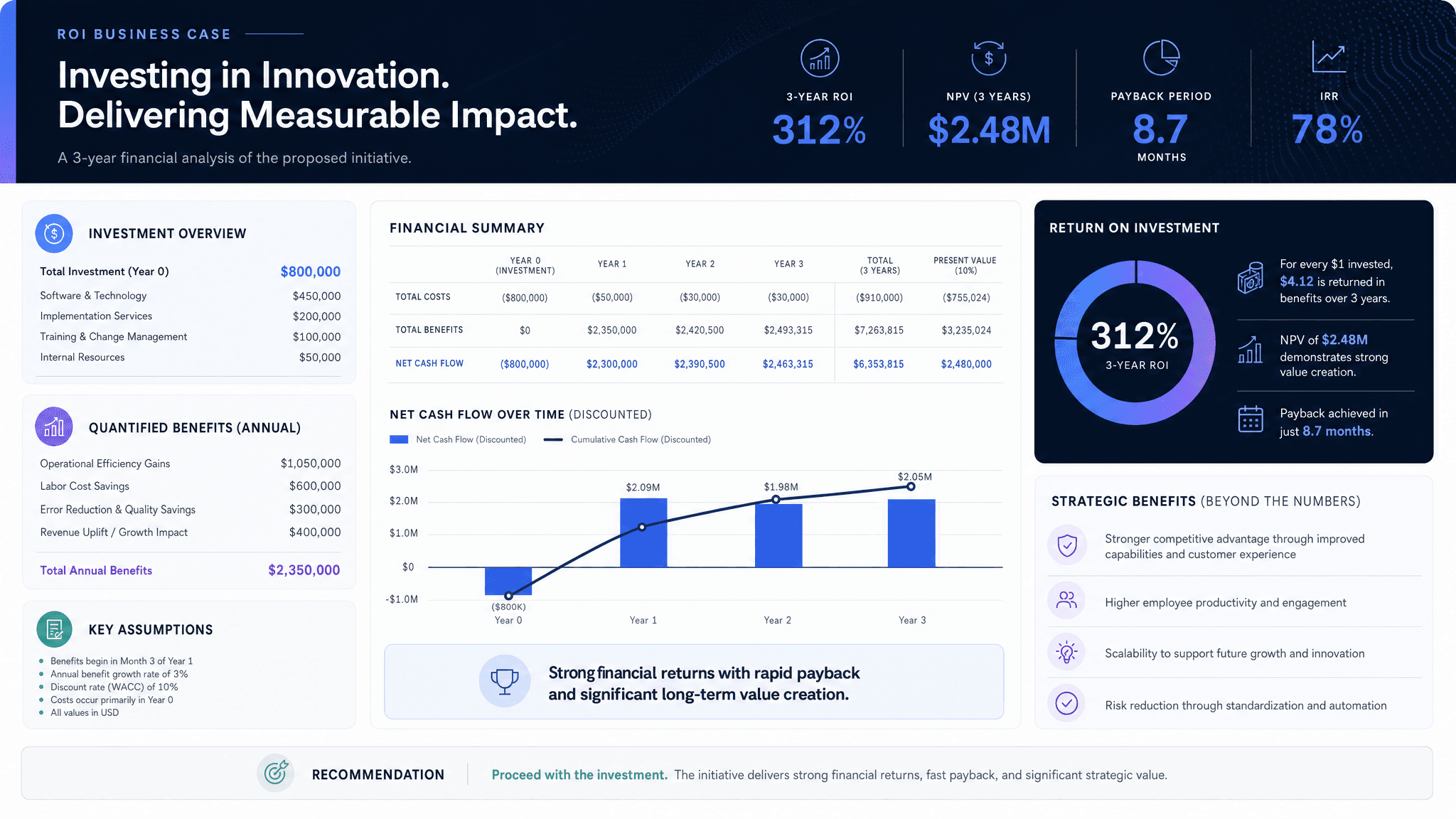
ROI pages go wrong when they pretend the math is more precise than it is. A useful business case shows the assumptions, explains the value drivers, and gives the buyer a way to challenge the numbers without throwing out the whole argument.
Claude can turn discovery notes, pricing, usage assumptions, current costs, customer proof, and implementation details into a readable ROI case. Send makes it easy to share with finance, leadership, or procurement as the deal moves.
What to include in the ROI business case
- The buyer's current problem and cost of doing nothing.
- Value drivers: time saved, revenue gained, risk reduced, cost avoided, or productivity improved.
- Assumptions behind each estimate.
- Estimated impact, investment, payback period, and sensitivity notes.
- Proof from customers, pilots, benchmarks, or internal data.
- Risks, caveats, implementation needs, and owner.
- Approval path and next step.
Prompt to use in Claude
Search the registry for the Send connector. Once connected, use their "send/roi-business-case" skill.
How to create it with Send
Give Claude the discovery notes, pricing, current workflow costs, volume assumptions, customer proof, and implementation details. Ask it to create an ROI business case with the Send connector. Make Claude show assumptions plainly instead of hiding them behind a polished conclusion.
Send gives the buyer a page they can forward to finance or leadership. If assumptions change after a call, Claude can update the same page so the business case stays current.
ROI business case structure
Current state
The buyer's problem, baseline costs, and why the status quo is expensive.
Value drivers
The ways the solution may create value and the assumptions behind each one.
Estimated impact
Investment, expected return, payback period, sensitivity, and caveats.
Proof and approval
Supporting evidence, risks, owner, and next step.
Why send an ROI business case as a page
ROI arguments often get separated from the assumptions that make them credible. A Send page keeps the math, caveats, proof, and next step together so stakeholders can inspect the case instead of guessing what the number means.